
Built for then, not for now. 5 ways to tell if your business has outgrown its original brand.
There’s a common misconception that businesses only need branding when they’re brand new. A founder launches a company, invests in a logo, builds a website, orders business cards, and checks branding off their list altogether.
Years pass, the company grows, and revenue increases. New services are added, employees are hired, better clients come onboard, and the business evolves. But oftentimes, the brand remains exactly the same as it did from that founding moment.
Eventually, something begins to feel off. The business is succeeding, but the brand no longer reflects the company behind it. And while many business owners can recognize this feeling, they often struggle to identify the exact thing that’s causing it.
The reality is that a successful business often outgrows its brand within the first 5 years. The challenge isn’t that the original brand was wrong, it's that the business has become something larger than what the identity was originally built to support.
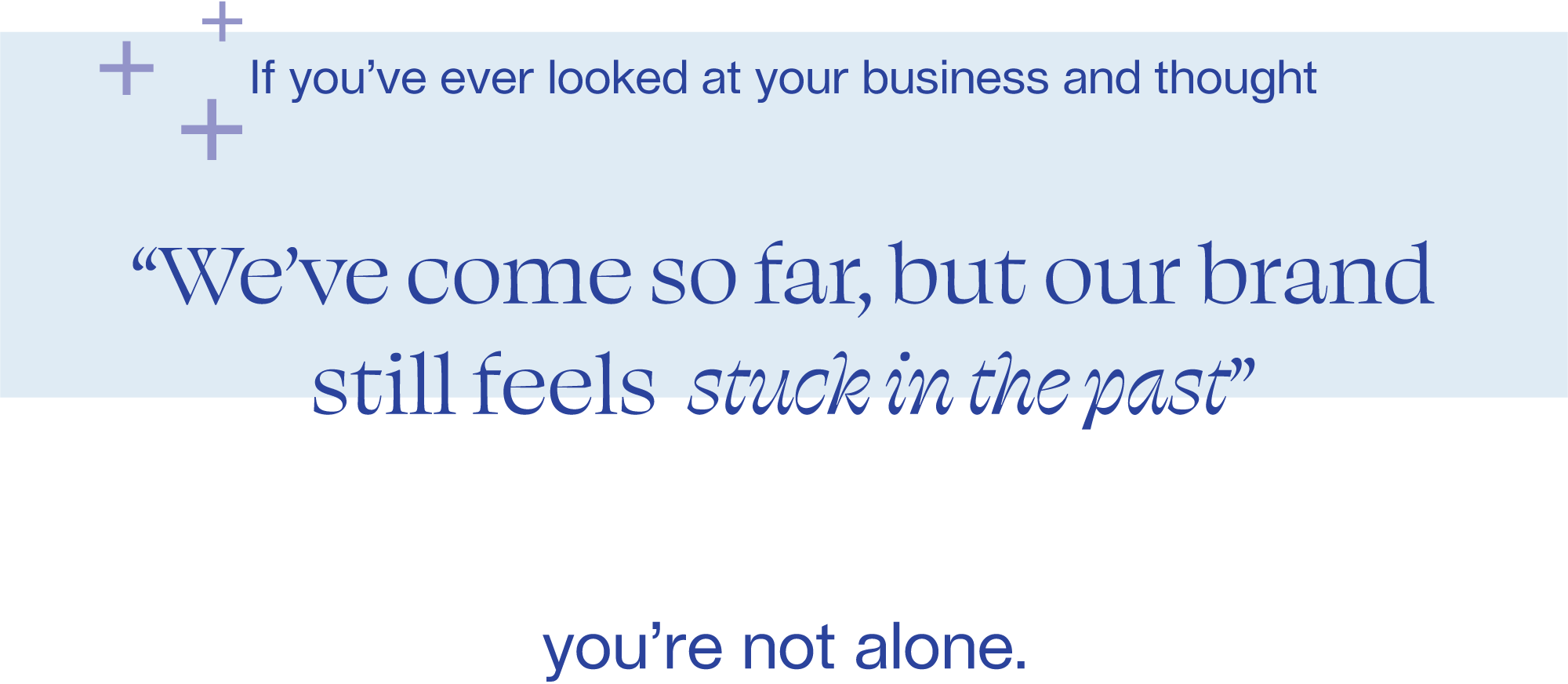
Here are five of the most common signs that your business has outgrown its original branding.
01 YOUR BUSINESS HAS CHANGED, BUT YOUR BRAND HASN’T
When customers encounter branding that reflects your past rather than your present, they underestimate your capabilities before ever speaking to you. The services you offer today may be completely different than when you started. You may have expanded your offerings, increased your pricing, hired a team, or shifted your positioning entirely. What once accurately represented your company may now be representing the wrong message.
This becomes especially problematic when your brand still looks like a startup while your business operates like an established company. Potential customers may assume you’re smaller, less experienced, or less capable that you actually are. In many cases, they’re comparing your outdated brand against competitors whose branding more accurately reflects their current position in the market.
02 YOU’RE ATTRACTING THE WRONG TYPE OF CUSTOMERS OR CLIENTS
One of the clearest signs that a brand is in need of an evolution is when you’re consistently attracting the wrong type of inquiries. Perhaps you’re trying to move into larger projects but continue receiving entry-level work. Maybe you’ve increased your prices but still attract price-sensitive clients. Or perhaps you’re capable of serving larger clients, yet most opportunities coming through your door remain small. Whatever it is, your brand is playing a significant role in setting those expectations.
Everything from your logo and website to your messaging and photography influences who feels like your business is meant for them. If your company has evolved but your branding hasn’t, you may be sending signals that no longer align with the audience you’re trying to attract.
03 YOUR COMPETITORS LOOK MORE ESTABLISHED THAN YOU DO
Every business owner can relate. You come across a competitor’s website, socials, or marketing and immediately think, “They’re not nearly as good of a service as we are, but they look so much better.”
Maybe you have more experience, stronger work, or your processes are more refined. Yet somehow their business feels more established, premium, and more trustworthy at first glance. While it’s frustrating, it highlights an important reality about buying behavior:
People often make judgements before they have enough information to understand the actual quality of the service. Customers use visual cues to estimate credibility when they’re doing research. They look at websites, branding, photography, messaging, and presentation to determine whether a company feels legit. This doesn’t mean perception matters more than performance, rather that perception determines who gets the opportunity to begin with.
04 YOUR BRAND FEELS INCONSISTENT ACROSS YOUR MARKETING EFFORTS
This often happens gradually. A website update is completed one year, new marketing materials are created the next, and your social media strategy evolves. Oftentimes, assets are inconsistent across elements and your brand colors, typography, and logo marks become fragmented. Over time, each piece is developed to solve a specific problem, but no one is looking at how everything fits together in the bigger picture.
Customers may not be able to identify exactly what’s wrong, but they can feel when a business identity lacks cohesion. Consistency builds trust because it signals professionalism, attention to detail, and confidence in who you are as a company. Inconsistency creates friction, forcing customers to work harder to understand what sets your business apart.
As businesses grow, branding naturally becomes more complex. New services require new marketing materials. Additional team members begin creating content. Vendors contribute to websites, advertising, photography, packaging, and sales collateral. Without an intentional system guiding those efforts, the brand slowly drifts apart. What once felt unified becomes a collection of disconnected pieces that no longer reinforce one another.
05 YOU’RE EMBARRASSED TO SEND PEOPLE TO YOUR WEBSITE OR HAND THEM YOUR BUSINESS CARD
And sometimes you don’t even realize you’ve outgrown something until it’s time to show it off and you experience that ever familiar moment of hesitation. A referral asks for your website, and instead of giving them the address, you find yourself making excuses like “the website is a little outdated” or “we’ve changed a lot since that was built”.
Deep down, you know the business has evolved past what those materials represent. The quality of your work has improved, your expertise has grown, and your offerings have become more refined. Yet the assets representing your company haven’t kept the pace.
The strongest brands create a certain level of confidence that can’t be defined. They make business owners proud to send prospects to their website and excited to share their company with others. When the thought of directing someone to your business makes you cringe, it’s a clear sign that your business has moved forward while your branding has been left behind.
Your brand should be able to evolve with you
The best brands aren’t built for the business you have today, but the one that you’ll have next year. If your company has grown significantly over the last several years but your brand still reflects on the business you started, it may be time to evolve the system that’s supporting it.
At Maker + Made, we help established businesses evolve their brands through strategic identity design, websites, packaging, and marketing systems that support long-term growth. Not just where the business has been, but where it’s headed next.