
Retail Ready or Rejected?
A packaging checklist for founders preparing for wholesale, retail placement, and their next stage of growth.
For so many founders, getting into retail brick & mortars is a major milestone. It represents the moment that your business transitions from something people discover on your website to something that can really stand on its own on a shelf. The product has proven itself, customers are responding, and opportunities are starting to appear. Maybe a local boutique reached out, maybe you’re preparing for your first trade show, or maybe you’ve spent years dreaming about seeing your product on a shelf and finally have the chance to make it happen.
Whatever it is, you’ve made it. And now it’s time to make sure your packaging design does everything it can to help you get chosen.
When you sell directly to customers, you have the luxury of context. People can visit your website, browse your social channels, read your story, watch videos, and spend time understanding what sets your brand apart from others. Retail doesn’t work that way. On a shelf, your packaging only gets a few seconds to earn attention, communicate its value, and build trust.
That’s why great products sometimes struggle in retail environments. It’s not because your product isn’t great, it’s because your packaging isn’t ready for the opportunity your business is stepping into.
If you’re preparing for retail growth, here are six things worth checking off your list before your product lands in front of a potential buyer.
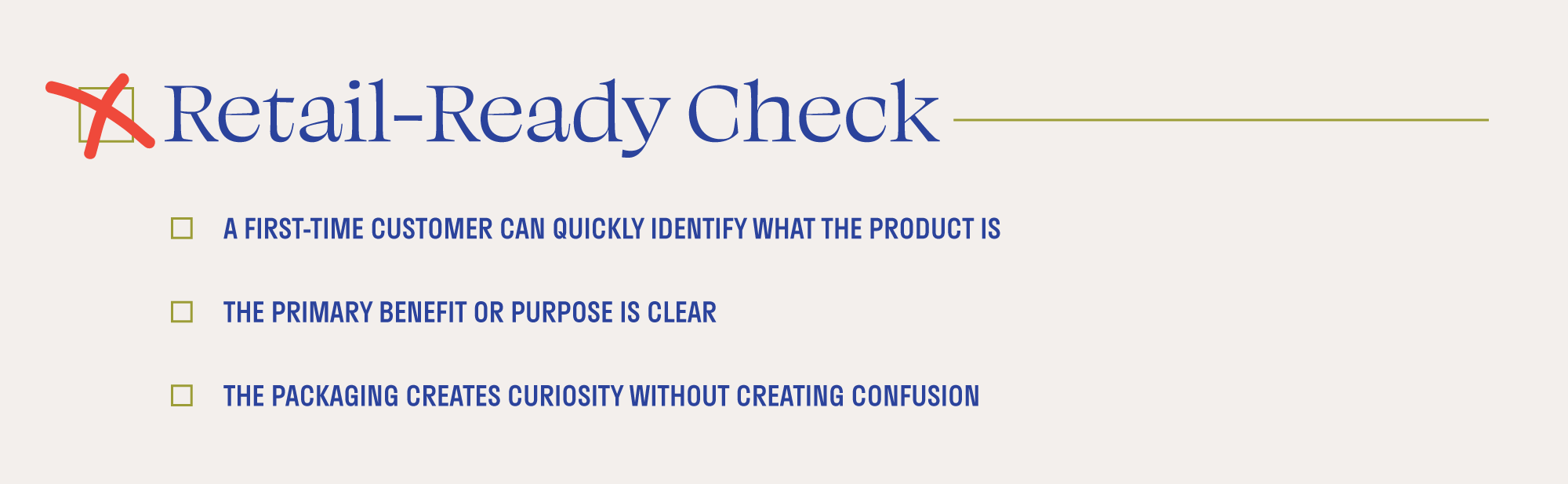
01. CAN SOMEONE UNDERSTAND WHAT YOUR PRODUCT IS QUICKLY?
One of the most common mistakes that founders make with their packaging is assuming that their customers know more than they actually do.
By the time you’ve developed the product, you’ve spent months (or years) immersed in it. You know every ingredient, feature, sourcing decision, and benefit. The product feels obvious because you’ve lived with it for so long. Customers, however, are seeing it for the very first time.
When someone encounters your product on a shelf, they’re quickly trying to answer a few simple questions:
What is this?
Is it for me?
Why should I care?
If those answers aren’t immediately clear, the product often loses momentum before the customer ever picks it up. A beautiful design unfortunately can’t compensate for confusion.
Retail-ready packaging prioritizes clarity before creativity, and the best ones have the two in perfect balance. That doesn’t mean boring, it means that customers shouldn’t have to solve a puzzle before understanding what they’re looking at. The easier it is for someone to understand your product, the easier it becomes for them to buy it.
02. DOES YOUR PACKAGING LOOK LIKE IT BELONGS IN THE STORES YOU'RE TARGETING?
One of the biggest mistakes that business owners make when preparing for retail is assuming that getting onto a shelf is all about having a stellar product. While that’s certainly the first step, retailers really care about the fit of the product itself.
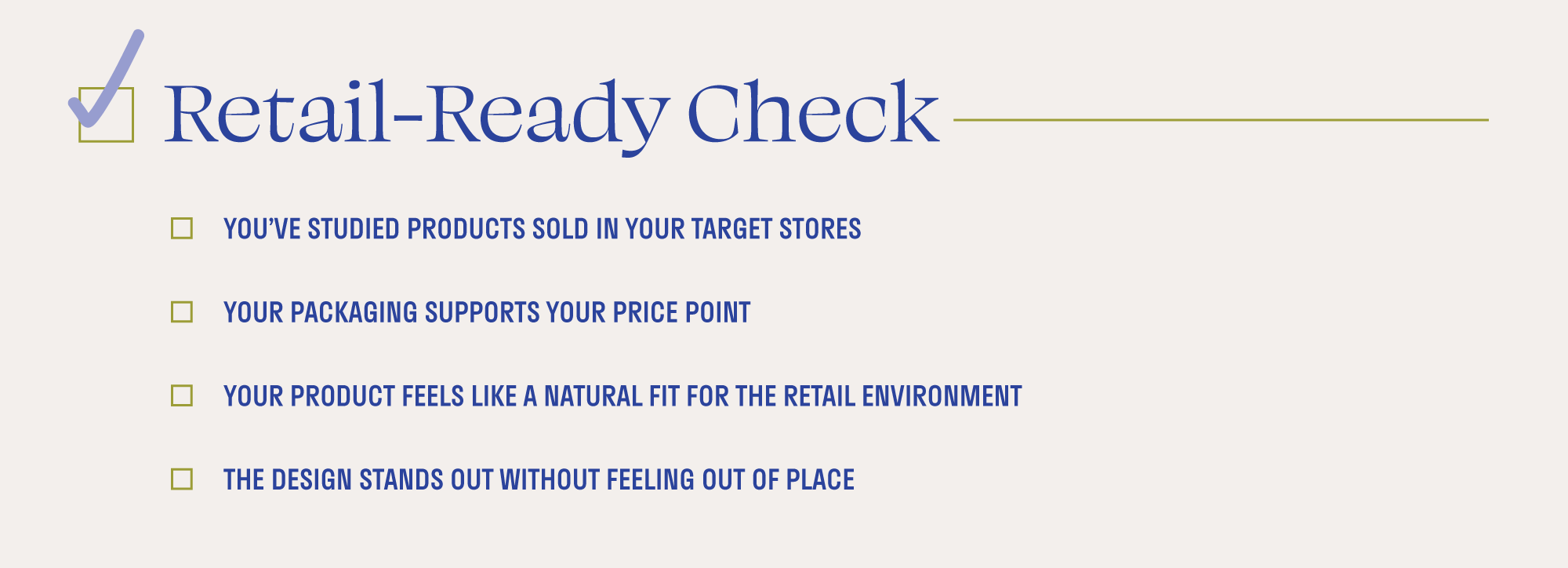
Every store has a particular customer, aesthetic, price point, and shopping experience they’re trying to create. When a buyer evaluates a new product, they aren’t just asking if it’s good, they’re asking whether it makes sense alongside all of the other products they already carry.
Imagine walking into your dream retailer tomorrow. Would your product feel like it belongs there? Would it look comfortable sitting next to the other brands already on the shelf?
This doesn’t mean that your packaging should mimic everyone else’s aesthetic. In fact, it shouldn’t. But there’s a difference between standing out and feeling out of place.
The strongest brands understand the environment they’re entering. They know what customers expect from the category, what visual cues communicate quality, and what level of presentation supports the price point they are asking. Their packaging feels familiar enough to build trust while remaining distinctive enough to earn attention.
Before pitching retailers, spend time studying the shelves you want to be on. If your product showed up there tomorrow, would it feel like a natural addition to the assortment, or would it feel like it accidentally wandered into the wrong store?
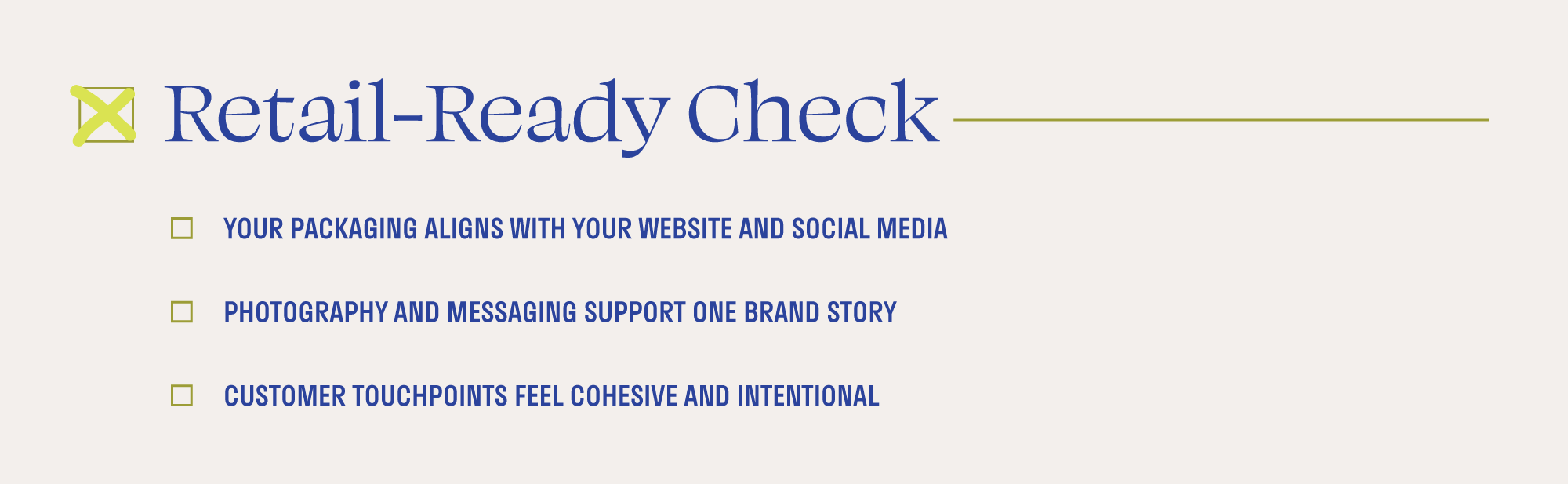
03. DOES YOUR PACKAGING FEEL CONNECTED TO THE REST OF YOUR BRAND?
Retailers aren’t just evaluating your packaging design, they’re evaluating your brand. If a buyer likes your product, there’s a good chance they’ll visit your website, browse your social channels, look at your photography, and see how the whole business is showing up online. They’re trying to figure out whether this is a brand that feels ready, reliable, and capable of supporting retail growth.
This is where inconsistency gets a little loud. If the packaging feels polished but the whole website feels outdated, there’s friction. If social media sounds like an entirely different company or your product photos, messaging, and packaging are all telling slightly different stories, the brand can feel less established than it really is.
Retail-ready brands feel cohesive. The packaging, site, photography, messaging, and customer experience don’t have to feel identical, but they should all be a part of a larger story. That kind of consistency builds trust with not only your customers but with your buyers, and their trust matters when they’re deciding whether to place your product on their shelf.
04. DOES YOUR PACKAGING INCLUDE WHAT RETAILERS AND CUSTOMERS EXPECT IT TO HAVE?
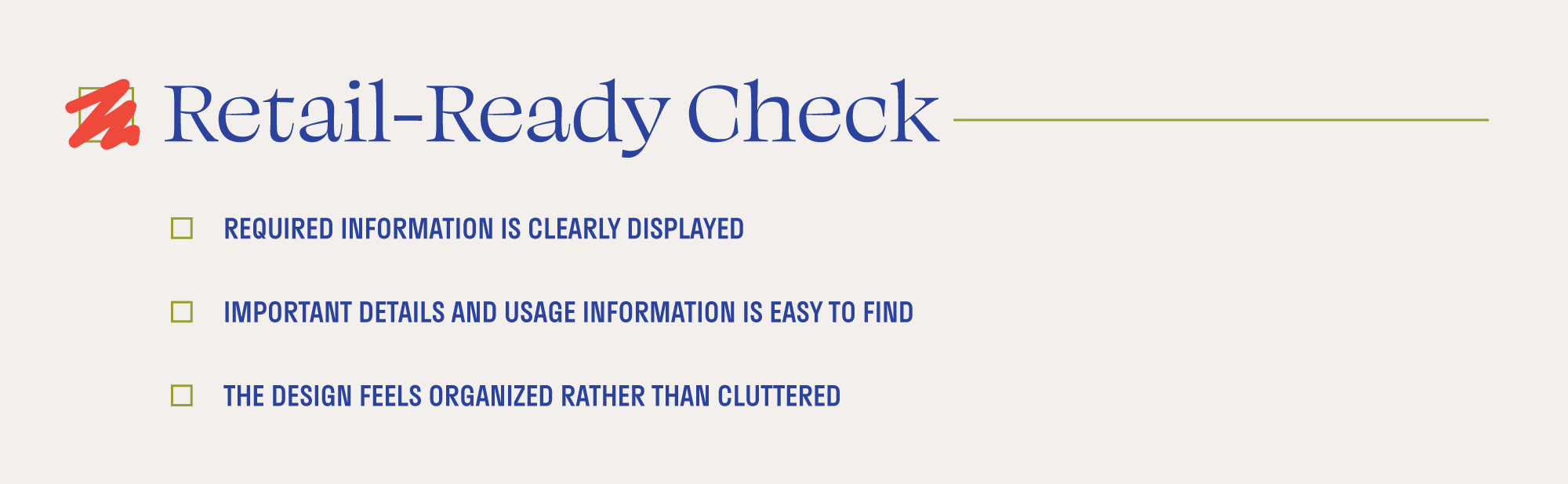
A customer shouldn’t have to flip, squint, search, and emotionally commit to a scavenger hunt to find the scent, flavor, size, ingredients, usage, or product benefits. Retailers also need to know that those practical pieces of information are covered. Missing information might seem small, but in retail, small friction can become a very easy reason to press “pass” on a product.
Depending on your category, your packaging might need product descriptions, ingredients, usage directions, net weight, UPC codes, manufacturer information, warnings, and other required details. The trick is not to cram everything onto the front panel like a panicked group project, but to create a clear hierarchy so people can find what they need as they scan your design.
Retail-ready packaging balances storytelling with practicality. It gives people the information they need, in the order they need it, while still feeling thoughtful, beautiful, and on-brand.
05. CAN YOUR PACKAGE SURVIVE IN REAL LIFE?
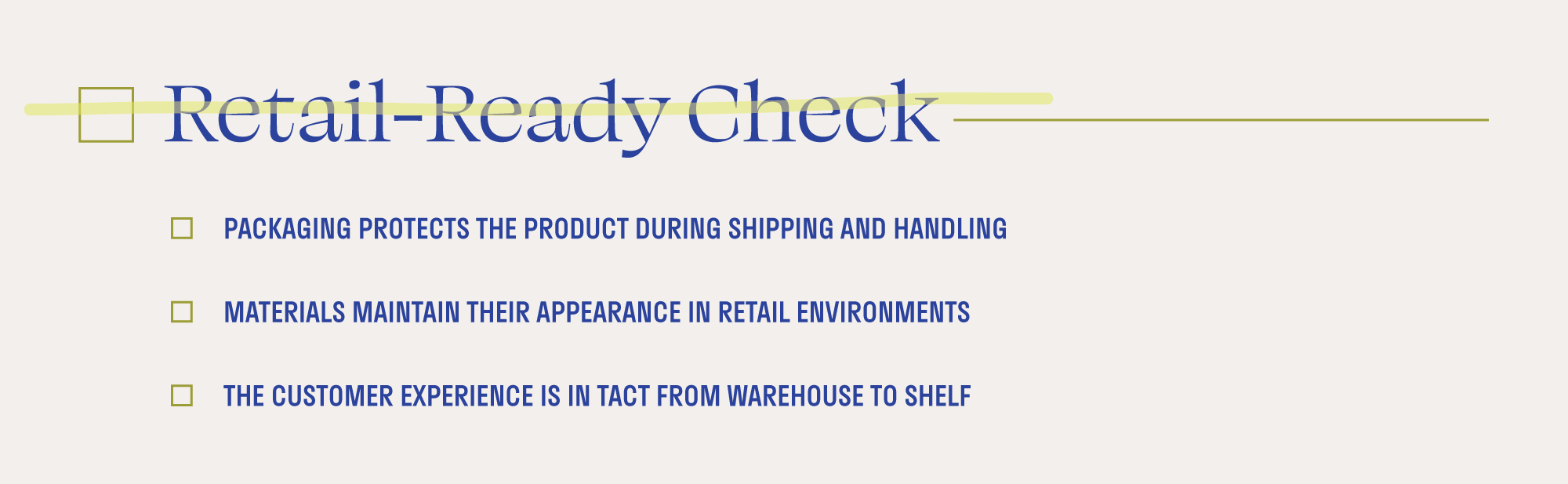
Packaging is often designed in a “best case scenario” type of environment. Perfect mockups, studio lighting, and no smudges in sight.
Unfortunately, retail isn’t that gentle.
Before your product even reaches a customer’s hands, it may be packed, shipped, unpacked, stocked, moved, restocked, dropped, squeezed, handled by curious shoppers, and shoved into a bag with someone’s keys. The packaging has to hold up beyond the photoshoot.
If your labels peel, your boxes dent easily, the material scuffs, or the product arrives looking tired before it ever gets displayed, that affects more than just aesthetics. It affects trust, and most of all, sales. Customers often associate the condition of the packaging with the quality of product inside, and retailers notice when products are difficult to store, stock, or keep looking good.
Beautiful packaging is everything, but it needs to survive the shipping box and retail shelf in one piece.
06. WOULD YOU FEEL CONFIDENT HANDING YOUR PRODUCT TO A RETAILER TODAY?
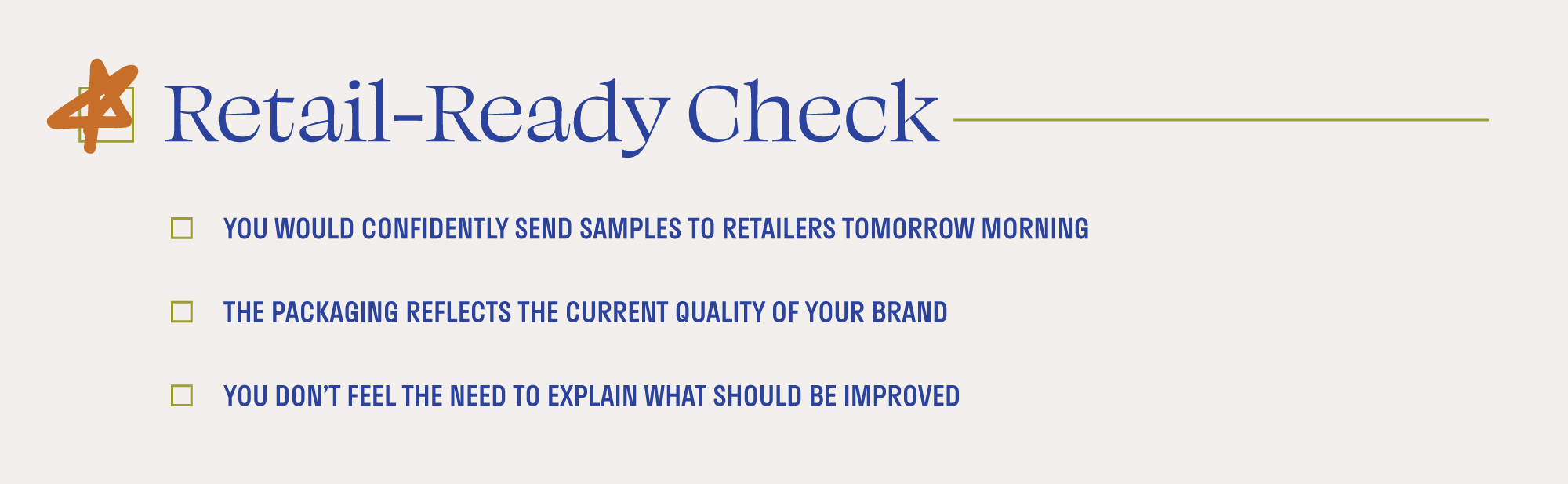
This is the simplest yet most telling question on the list. If your dream retailer asked for a sample this afternoon, would you feel excited to send it to them? Would you confidently place your product on the table during a meeting? Or would you immediately start explaining the things you’re planning to update, fix, redesign, or get around to?
You know the answer.
That hesitation doesn’t mean your packaging is bad, it may just simply mean the brand has outgrown it. Maybe your product is more refined now, or the audience has shifted. Potentially your price point has increased or your business is ready for a bigger opportunity, but the packaging is still representing an earlier version of your brand.
Retail-ready packaging creates confidence in the founder. It lets the product speak clearly. It helps you stop apologizing for what’s missing and start showing up like your brand is meant to be there — because you are meant to be there.
Retail-ready packaging isn't about checking boxes for the sake of checking boxes. It's about building confidence.
Confidence for the customer choosing between your product and the one next to it. Confidence for the retailer deciding whether your brand belongs on their shelf. And confidence for you as the founder, knowing the product you've worked so hard to create is being represented at the level it deserves.